
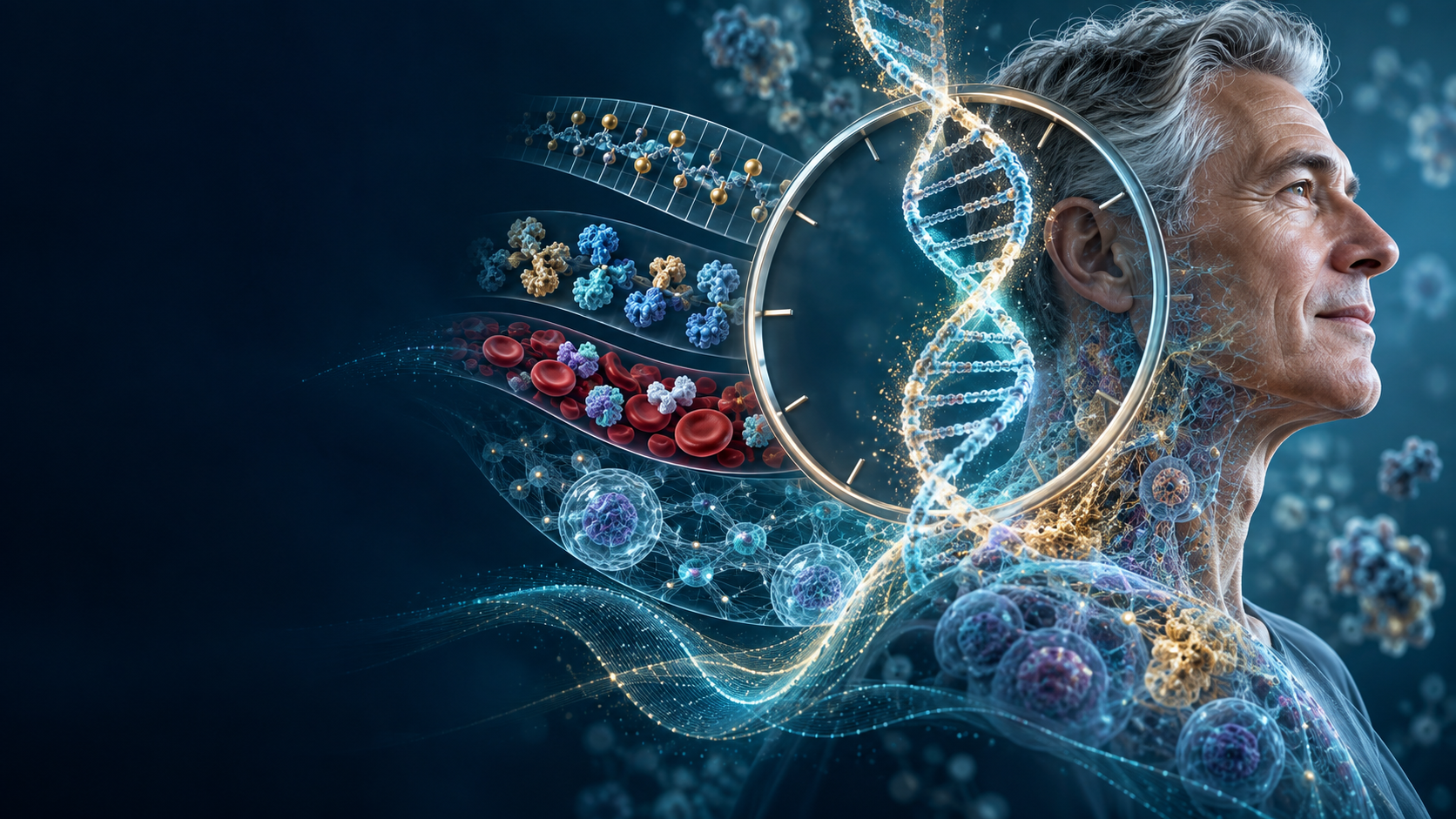
A biological clock is not a crystal ball. It describes probability, not destiny.
We can measure blood pressure in a few minutes. We assess glucose, cholesterol, and kidney function with standardized laboratory analyses. But what if we could measure something far more complex — the speed at which a person is aging?
The idea is both scientifically appealing and clinically important. If we had a reliable "thermometer of aging," we might be able to detect deteriorating health before symptoms appear and better identify who is at greatest risk of functional decline and disease. This is precisely why biomarkers of aging have become one of the most dynamic fields of geroscience and longevity medicine.
Over the past decade, epigenetic, proteomic, metabolomic, immunological, and digital clocks have been developed. Today, artificial intelligence can link thousands of biological and clinical data points and turn them into a seemingly simple result: an estimated biological age. But behind a single number lies a far more complex story.
Why isn't age in years enough?
Chronological age tells us how much time has passed since birth. It is precise, universal, and simple to determine, but it does not fully describe a person's health and functional state. Two people who are both 60 years old can differ significantly in blood pressure, metabolic health, muscle strength, cardiorespiratory fitness, cognitive function, and the presence of chronic disease. Biological age attempts to describe exactly that difference.
However, biological age is not a physical quantity like temperature, length, or mass. There is no single instrument that can measure it directly — it is a modeled estimate derived from data we assume reflect certain aspects of aging. This is why different biological clocks can produce different results in the same person, and all of them can be mathematically correct.
What would an ideal biomarker of aging look like?
An ideal biomarker should not merely distinguish younger from older people — a large number of parameters that change with age can already do that. It is far more important that it shows something clinically useful: that it reflects the fundamental biological processes of aging, that it predicts future health outcomes better than date of birth alone, and that it reliably registers change when an intervention genuinely improves health.
Measurement would have to be reproducible and validated across different populations, ages, and health states. Ultimately, the result would have to change a decision — to help choose an intervention, assess risk, or monitor its effect. This is precisely where the greatest challenge lies: many existing clocks are very good at recognizing patterns associated with age, but it has not yet been proven that each of them can reliably guide an individual clinical decision.
From telomeres to epigenetic clocks
Telomeres were long presented as the most logical biological clock — these protective structures at the ends of chromosomes progressively shorten through repeated division of many cells. The relationship between telomeres and aging is biologically important, but measuring their length alone has numerous limitations, so telomeres did not become a universal "lifespan gauge." Scientific inquiry then turned toward epigenetics.
What is an epigenetic clock?
One of the most frequently studied epigenetic processes is DNA methylation — chemical marks that attach to specific sites in the genome and participate in regulating gene activity. An algorithm can analyze a large number of such sites and, based on their shared pattern, estimate the age of a sample. This is the basis of the epigenetic clock.
The result, however, is not a direct reading of age — it is the product of a statistical model that has learned the relationship between certain methylation patterns and a chosen outcome. If the model was developed to predict mortality, disease, or loss of function, the result will reflect more of a combination of aging and health risk. This is why not all epigenetic clocks are interchangeable.
The Horvath clock — an important scientific milestone
In 2013, Steve Horvath presented an epigenetic clock capable of estimating the age of various human tissues and cell types, using a methylation pattern at 353 sites in the DNA. Its significance lay not only in its precision — for the first time it was shown that a large number of different tissues share a recognizable epigenetic pattern associated with aging, which opened an entirely new field of research.
Still, the original Horvath clock was primarily developed to predict chronological age — a good result in that task does not automatically mean the clock precisely measures physiological damage, health risk, or the effect of a given intervention. For this reason, new generations of clocks emerged.
Not all clocks are built to measure the same thing
Later generations began to incorporate clinical biomarkers, smoking status, health-related proteins, and mortality data — their goal was no longer simply to answer "how old is this sample," but to estimate risk associated with aging. Models such as PhenoAge and GrimAge therefore do not measure exactly the same biological dimension as the original clocks. DunedinPACE, for example, attempts to estimate the pace of aging — how much biological change accumulates over a given period of time.
When two tests give different results, this does not necessarily mean one of them is wrong — it is possible they are looking at different aspects of the same complex process.
What does it mean if a test shows we are "older" than we are?
Suppose a person is 50 years old and an epigenetic clock shows 58. The simplest interpretation would be that the person is biologically eight years older, but such a conclusion is too literal. The result actually indicates that the pattern the algorithm analyzed resembles the average pattern of a reference group older than that person — this can represent a signal of increased risk, but it does not say when disease will develop or how long the person will live.
The same applies to a result showing a "younger" biological age — it can be a favorable sign, but it is not confirmation that all organ systems are younger or that preventive checkups are no longer needed.
Has the result truly changed, or is it just variation?
This question is especially important when a biological clock is used to assess the effect of a diet, supplement, or exercise program. Every measurement contains a certain amount of technical and biological variability — the result can be affected by sample quality, laboratory processing, acute infection, and medications. If a test shows a two-year reduction in biological age after three months, we need to know whether the change exceeds the method's expected error and, more importantly, whether the change in the result tracks real improvement in health.
This is why serious monitoring requires using the same method, the same type of sample, and conditions that are as similar as possible. A single isolated result has much less value than a carefully tracked trend.
Blood as a map of organ aging
The development of proteomics has opened a new possibility: estimating aging by analyzing a large number of proteins in the blood. Particularly interesting is the development of organ-specific proteomic clocks, which, instead of a single age for the whole body, attempt to assess whether the heart, liver, kidneys, immune system, or brain show more pronounced patterns of aging — an approach that matches the biological reality that not all of a person's organs likely age at the same rate.
Studies show that proteomic patterns can be associated with disease risk and mortality, but organ-specific "age" is still a modeled estimate, not a direct measurement of each organ's condition.
Metabolomic and immunological clocks
The metabolome encompasses a large number of small molecules generated by cellular and metabolic processes, whose pattern depends on genetics, diet, the microbiome, medications, and health status. Metabolomic clocks can be very sensitive to current metabolic state — which is also their limitation, since the result can depend on a recent meal or the timing of sample collection.
Immunological clocks analyze changes in the number, ratio, and function of immune cells and inflammatory signals, but here too there is no single universal pattern that applies equally to all people and all health states.
Artificial intelligence: a powerful tool, but not new biology
Artificial intelligence enables analysis of a volume of data that a human cannot process at once — AI models can link laboratory results, medical imaging, epigenetic data, proteins, and sleep patterns to estimate biological, vascular, brain, or metabolic age. But AI does not measure aging directly — it recognizes patterns it has learned from data.
The quality of the result therefore depends on the quality of the data and the question posed during the model's development. A particular challenge is interpretability — the physician and the patient need to know which factors most influenced the result and whether it is possible to act on them safely. A complex algorithm is not automatically better than a simple clinical indicator.
Sometimes the body speaks more clearly than a molecular clock
While science develops sophisticated molecular tests, some of the most important indicators of healthy aging remain surprisingly simple. The way a person walks, rises from a chair, maintains balance, or tolerates physical exertion says a great deal about the combined function of muscles, heart, lungs, blood vessels, and the nervous system.
Grip strength is a practical indicator of overall muscle strength. Cardiorespiratory fitness shows how efficiently the body uses oxygen during exertion — the American Heart Association has proposed viewing it as an important clinical vital sign. For a patient, it is often more important whether they have gotten stronger and reduced their risk of falling than whether an algorithm has lowered their estimated age from 57 to 54.
Where do standard laboratory findings fit in?
Biological clocks often seem more sophisticated than routine laboratory testing. Still, blood pressure, glycemia, HbA1c, lipid status, kidney function, and body composition have clearly confirmed clinical value — they do not measure overall aging, but they identify risk factors we can specifically act on. It is most useful to look at individual biomarkers and their combined picture together, rather than reducing an entire health profile to a single estimated age.
Genetics shows predisposition, not the speed of the clock
Genetic tests can identify variants associated with metabolism, drug response, or risk of particular diseases, but a standard genetic analysis does not measure biological age. The DNA sequence largely stays the same throughout life, whereas biological clocks mostly analyze changes in gene regulation, proteins, or function. Genetics can help us understand part of a predisposition, but it gains real meaning only in combination with family history and clinical status.
Functional tests are not clocks of aging
Hormone panels, the DUTCH test, microbiome analysis, and other specialized tests can answer certain clinical questions, but they do not directly measure biological age. The value of these tests does not depend on how technologically advanced they are, but on whether they answer a clear clinical question and change a decision.
Do we need a single longevity test?
Probably not. Aging is not a single process — genomic changes, epigenetics, metabolism, proteostasis, inflammation, mitochondrial function, immunity, and functional capacity do not change at the same rate in every person. It is far more likely that the future will belong to multimodal models that combine molecular, clinical, functional, and digital data. Still, adding more data does not automatically guarantee better medicine — every new marker must prove that it improves assessment, changes a decision, or enables more effective monitoring.
How to use biological clocks responsibly?
Before testing, it is necessary to know whether the test is intended for research, risk assessment, or monitoring change, to use a validated method, and to understand its margin of error. When tracking an intervention, the test should be repeated under similar conditions, and the change should be viewed together with clinical parameters and the patient's subjective state.
Most importantly, the result should not provoke unnecessary fear or false reassurance. A person whose clock shows accelerated aging has not received a diagnosis of inevitable disease. A person with a "younger" result is not exempt from the need for preventive checkups.
What has the greatest practical value today?
While we wait for more reliable and better-standardized clocks, the greatest clinical value still lies in an integrated health assessment that links history and examination with blood pressure, metabolic status, body composition, physical capacity, sleep, mental health, and the presence of disease. That is why the most important question before any test is: what will we do differently once we have the result?
Conclusion
The goal is not to get the youngest possible number. The goal is to preserve the body's health, function, and resilience for as long as possible.
We can measure aging better today than ever before, but a single universal and infallible test still does not exist. Epigenetic, proteomic, metabolomic, and AI clocks recognize different patterns associated with aging — each of them observes only part of a complex biological system. For this reason, biological age is neither a final verdict nor a precise date for future disease.
The best approach does not pit advanced technology against clinical medicine. It connects them: molecular data can reveal what we cannot yet see, functional tests show what a person is capable of, standard biomarkers identify risks we already know how to act on, and clinical context determines what all of it means for a specific person.
AFLM — knowledge before technology
The Academy for Functional and Longevity Medicine links current scientific advances with responsible clinical application. New technologies can be extremely valuable, but only when we understand what they measure, where their limits lie, and how a result can change a decision.
Knowledge before technology.
The clinical question before the test.
The patient before the result.
Sources
- Horvath S. DNA Methylation Age of Human Tissues and Cell Types. Genome Biology. 2013;14.
- Moqri M, Herzog C, Poganik JR, et al. Biomarkers of Aging for the Identification and Evaluation of Longevity Interventions. Cell. 2023;186:3758–3775.
- Oh HSH, Rutledge J, Nachun D, et al. Organ Aging Signatures in the Plasma Proteome Track Health and Disease. Nature. 2023.
- Bell CG, Lowe R, Adams PD, et al. DNA Methylation Aging Clocks: Challenges and Recommendations. Genome Biology. 2019.
- Ross R, Blair SN, Arena R, et al. Importance of Assessing Cardiorespiratory Fitness in Clinical Practice: A Case for Fitness as a Clinical Vital Sign. Circulation. 2016.
Note: This text is educational in nature and does not constitute individual medical advice. The result of a biological clock does not establish a diagnosis and should not be the sole basis for changing therapy, diet, supplementation, or lifestyle.