
"I don't have the energy I used to." This sentence is often heard after the age of forty or fifty — but fatigue by itself does not prove mitochondrial dysfunction.
Fatigue, slower recovery, and declining physical endurance are easily attributed to age, stress, or "slowed-down mitochondria." Mitochondria do indeed play a central role in energy production and in the aging process. However, fatigue can be associated with insufficient sleep, anemia, thyroid dysfunction, depression, infection, diabetes, heart or lung disease, medication side effects, and numerous other conditions. It is therefore important to avoid the simple conclusion that every lack of energy is a "problem with the cell's power plants."
The real story of mitochondria is both more complex and more interesting. They are not passive batteries that simply drain over time — they are dynamic cellular structures that constantly change shape, communicate with the rest of the cell, respond to physical activity, and decide which damaged parts need to be repaired or removed.
Energy without which there is no function
Mitochondria are found in almost all cells of the human body. Tissues with high energy demands, such as cardiac and skeletal muscle, the brain, the liver, and the kidneys, depend especially heavily on their function. In mitochondria, energy from nutrients, using oxygen, is converted into adenosine triphosphate, known as ATP — the cell's immediately available "energy currency," needed for muscle contraction, nerve-impulse transmission, maintaining ionic balance, and almost every active process in the body.
Still, mitochondria are not the only source of cellular energy, nor is ATP production their only function. They participate in calcium regulation, fat and amino-acid metabolism, heat production, immune response, and programmed cell death.
Mitochondria have their own genetic material
Unlike most cellular structures, mitochondria contain their own DNA, carrying a small but important portion of the information needed to build components of the energy system. Most mitochondrial proteins, however, are encoded in the DNA of the cell nucleus, which is why proper function depends on constant communication between the two genomes.
Mitochondrial DNA is inherited almost exclusively from the mother. Pathogenic changes in it can cause true mitochondrial diseases — rare, complex, and often multisystem disorders. These diseases should not be equated with the widely used term "mitochondrial dysfunction," which in aging research describes a change in energy metabolism and the signaling function of mitochondria. Clinical mitochondrial disease and age-related changes are not the same diagnosis.
What changes during aging?
Mitochondrial dysfunction is included among the twelve hallmarks of aging. This does not mean that mitochondria alone cause aging, but that their changes participate in a broad network of interconnected processes. With age, many people experience a decreased ability of certain tissues to efficiently produce energy — mitochondrial DNA damage can accumulate and quality-control mechanisms can weaken.
One of the key processes is mitophagy — the selective removal of damaged or unneeded mitochondria. At the same time, the cell can create new mitochondria through mitochondrial biogenesis. Healthy function therefore does not depend solely on the total number of mitochondria, but on the balance between their formation, repair, adaptation, and removal — a balance that aging, physical inactivity, metabolic disease, and chronic inflammation can disrupt.
A dynamic network, not static batteries
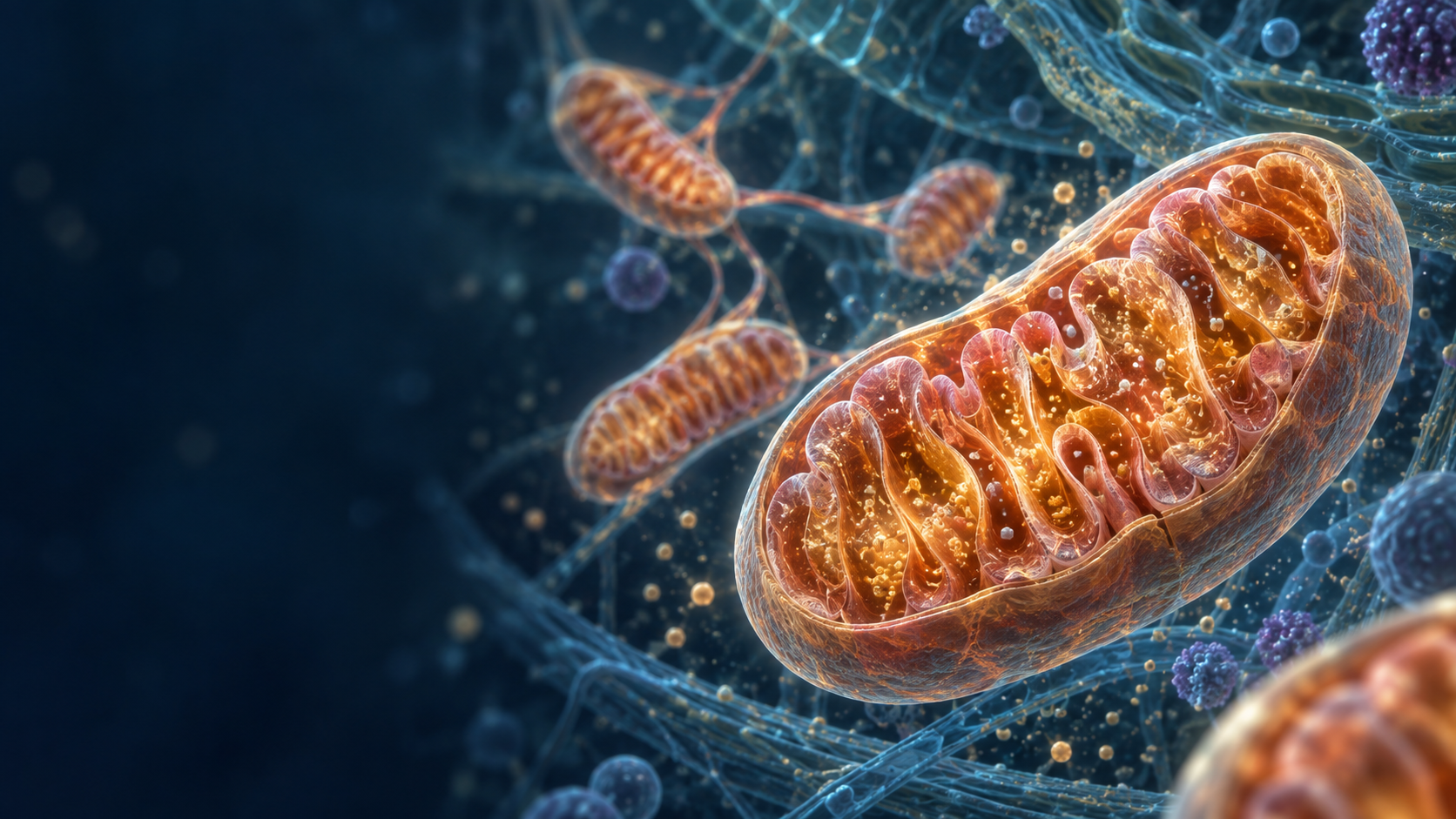
In illustrations, mitochondria are often depicted as individual bean-shaped structures. In a living cell they can form a changeable network — joining through the process of fusion and separating through fission. Fusion enables the exchange of contents, while fission contributes to separating off damaged parts that will be removed through mitophagy. Neither of these processes is inherently "good" or "bad" — health depends on their precise balance.
Mitochondria also continuously communicate with the cell nucleus. When their function is impaired, they send signals that change gene expression, metabolism, and the stress response — this communication helps the cell adapt, but it can contribute to disease when stress becomes strong or prolonged.
Free radicals are not only enemies
Reactive oxygen species arise during energy production. They were once viewed almost exclusively as harmful byproducts, but we now know the picture is more complex — in controlled amounts they also act as signaling molecules that participate in adaptation to exercise and the activation of the body's own antioxidant systems. The problem arises when their production exceeds the cell's capacity to control them, resulting in oxidative stress.
This explains why maximally "switching off" every oxidative signal is not necessarily desirable. High doses of isolated antioxidant supplements cannot be equated with food rich in natural bioactive compounds — some studies show that excessive supplementation with vitamins C and E can blunt part of the training adaptation. The goal, therefore, is not to eliminate oxidation but to maintain a balance between signal generation, antioxidant protection, and cellular repair.
The brain is an energy-demanding organ
Although it makes up a small portion of total body mass, the brain uses a large share of the body's energy at rest. Mitochondrial changes are studied in the context of Alzheimer's, Parkinson's, and other neurodegenerative diseases — changes in energy metabolism, oxidative stress, and mitophagy are observed. Still, this connection does not imply that "weak mitochondria" are the sole cause of neurodegeneration, nor that a supplement promising more cellular energy can prevent dementia. Mitochondria are an important part of that network, but not its only explanation.
Muscle is the greatest site for metabolic adaptation
Skeletal muscle is one of the tissues that most clearly adapts to physical activity. Endurance training can increase muscle mitochondrial content and the capacity to use oxygen and fatty acids, while strength training preserves or increases muscle mass, contributing to overall metabolic reserve. Physical inactivity works in the opposite direction — reducing the energy demands of muscle and potentially worsening insulin sensitivity.
For this reason, regular movement is one of the best-supported strategies for preserving mitochondrial function — not because it "rejuvenates" every mitochondrion, but because it continually drives adaptation and quality control in active tissues. The best effect usually does not come from a single type of activity: aerobic training develops the capacity to use oxygen, while resistance training preserves the muscle that uses that energy.
Can mitochondrial health be measured?
There is no single routine test that reliably determines the "age of mitochondria" for the whole body. Direct assessment of mitochondrial respiration is possible under specialized research conditions, but that is not the same as a standard preventive checkup. Lactate, creatine kinase, organic acids, and other laboratory parameters can play a role in evaluating certain symptoms, but none of them alone confirms a broadly defined "mitochondrial exhaustion."
For most people, more clinically useful information comes from assessing symptoms, blood count, thyroid function, glycemic regulation, cardiopulmonary health, nutritional status, sleep, medications, and physical capacity. A test has value only when it answers a clear medical question.
Where does genetics fit in?
Genetic testing is important when there is suspicion of an inherited mitochondrial disease or a clear family and clinical indication — such analysis requires appropriate genetic counseling. Common variants in genes related to antioxidant enzymes, such as SOD2, GPX, or CAT, are sometimes included in commercial wellness panels, but their individual effects are usually small and cannot directly measure mitochondrial function. Genetics can provide context — it should not replace clinical assessment.
Can a supplement improve mitochondria?
Coenzyme Q10, NAD⁺ precursors, alpha-lipoic acid, carnitine, creatine, and other compounds are often promoted as mitochondrial support. For certain substances there are specific medical indications, but that does not mean they are a proven means of slowing aging in a healthy population. An increase in the concentration of a particular metabolite in the blood is not the same as proof of a longer or healthier life — supplements can also have side effects and interactions with therapy.
What currently has the strongest scientific basis?
Strategies that support mitochondrial function are largely the same ones that preserve overall metabolic and cardiovascular health.
- Regular physical activity promotes mitochondrial biogenesis and adaptation.
- Strength training helps preserve muscle mass.
- A diet based on minimally processed foods provides the necessary substrates and micronutrients.
- Quality sleep supports metabolic regulation and recovery.
- Controlling blood pressure, glucose, and atherogenic lipoproteins reduces tissue damage.
These interventions may not sound futuristic, but the evidence behind them is incomparably stronger than for most commercial "mitochondrial rejuvenation" programs.
Energy is the capacity to adapt
Mitochondria are not a clock that simply counts down the years. They are a dynamic indicator of the relationship between biological inheritance, health, and the way we live.
Mitochondria alone do not determine how long we will live. They are part of a much broader network linking genes, metabolism, immunity, muscles, the nervous system, and the living environment. Their most important trait is not simply ATP production — it is the ability to adapt to changing energy demands, communicate with the cell, and replace damaged parts with more functional ones.
With aging, this flexibility can weaken. Still, the body retains a significant capacity for adaptation, particularly in response to regular movement. The question of healthy longevity is therefore not how to permanently preserve "young mitochondria," but how to preserve, throughout life, a system that can produce energy, respond to stress, and renew its own components.
Note: This text is informational in nature and does not constitute individual medical advice. Prolonged or unexplained fatigue, muscle weakness, and a decline in functional capacity require appropriate medical evaluation.