
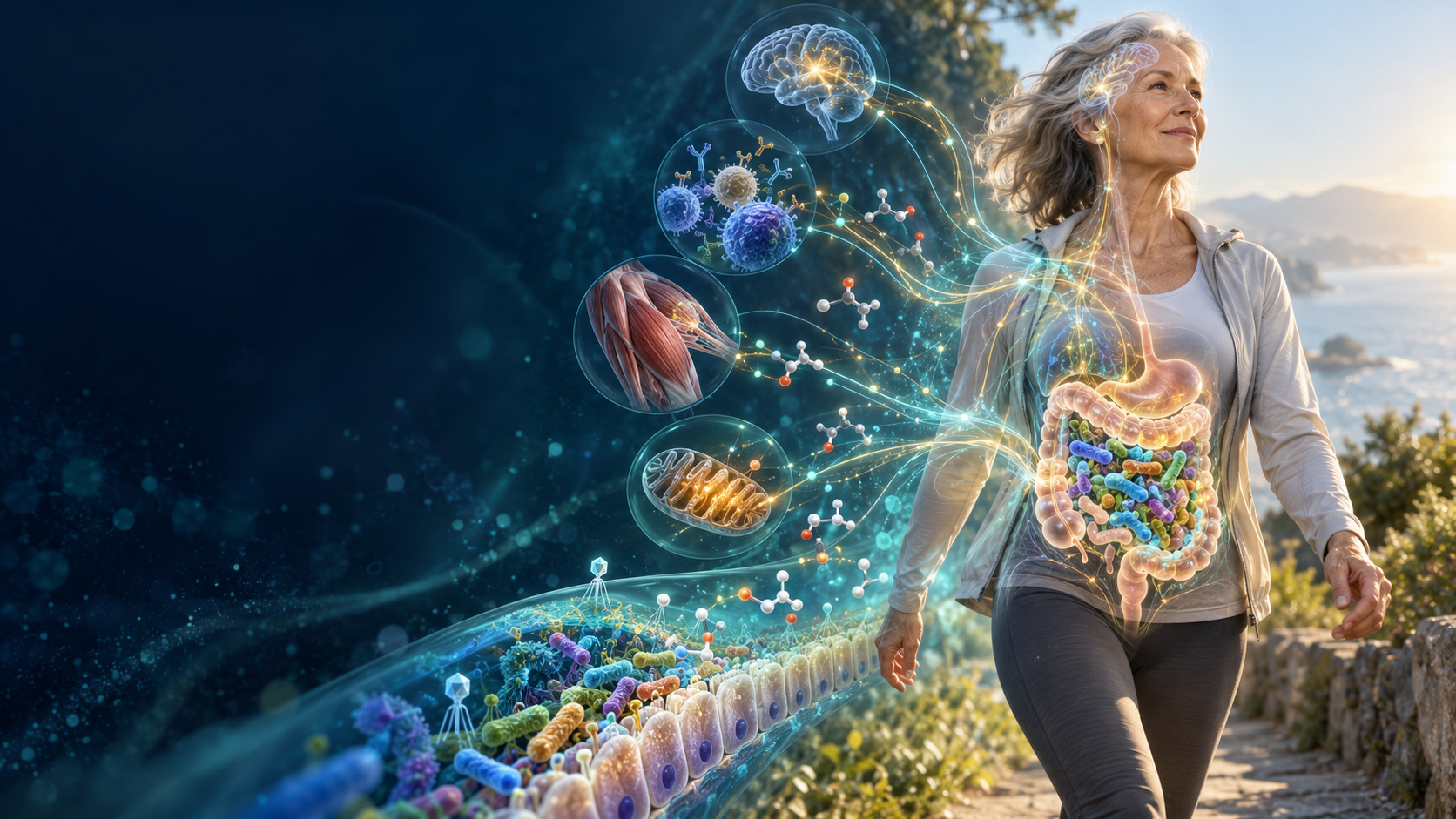
The real question is not only what lives in our gut. What matters more is what those microorganisms do and how they communicate with the host organism.
When we talk about aging, we usually think of the heart, the brain, muscles, hormones, and blood vessels. The gut usually comes up only when there are digestive complaints. Modern research is changing that view.
The gut hosts a complex community of microorganisms that participates in breaking down food, producing biologically active molecules, regulating the immune system, and maintaining the gut barrier. Changes in this community are linked to metabolism, inflammation, and health status throughout life. For this reason, dysbiosis was included among the twelve hallmarks of aging in 2023.
This does not mean the microbiome is the main cause of aging, nor that there is a single bacterium of longevity. It means that the relationship between humans and their microorganisms can no longer be viewed as a side topic — the microbiome is part of a broader biological network in which food, medication, living environment, immunity, and metabolism intersect.
We are not alone, but we are not merely a sum of microorganisms either
The human digestive system is home to bacteria, archaea, fungi, and viruses, collectively called the gut microbiota, while the term microbiome, in the broader sense, also encompasses their genes, functions, metabolites, and mutual relationships. Estimates show that the number of bacterial cells in the human body is roughly of the same order of magnitude as the number of human cells.
Microorganisms expand human metabolic capacity — they can break down components of food that our own enzymes cannot fully process, producing molecules that act locally in the gut but can also reach the circulation. It is not entirely accurate to call it a separate organ, because, unlike the heart or liver, its structure changes with diet, age, medication, geography, infections, and social environment. Perhaps it is best understood as an ecosystem that continually adapts to the conditions in which its host lives.
The microbiome does not age on its own
With age, the gut microbial community changes, but these changes are not determined solely by date of birth. An older person's microbiome can be strongly influenced by diet, number of medications, use of antibiotics and proton pump inhibitors, physical activity, presence of chronic diseases, reduced mobility, and changes in social environment.
In healthy, functionally preserved older people, the microbiome may be more stable and functionally more resilient. In people with frailty syndrome, multimorbidity, or very restricted diets, more pronounced changes are more often found. This does not prove that the microbiome is the sole driver of functional decline — the relationship is bidirectional: the microbiome may contribute to how we age, but it also carries traces of everything that has happened to our body throughout life.
What does dysbiosis actually mean?
Dysbiosis is often explained as a state with fewer "good" and more "bad" bacteria. Such a division is appealing but biologically too simplistic — the same bacterium can be beneficial in one context, neutral in another, and problematic when found in the wrong part of the gut or when its abundance increases disproportionately.
Dysbiosis is therefore not one clearly defined diagnosis. It describes an unfavorable change in the structure or function of the microbial ecosystem that may be associated with disease or increased vulnerability. This is especially important when interpreting commercial tests — a result showing a deviation from a reference database does not automatically mean disease is present, nor that every bacterium found outside the stated range needs to be "fixed."
Is a more diverse microbiome always healthier?
Microbial diversity is often presented as a universal sign of health. In many studies, lower diversity is indeed associated with certain diseases and with antibiotic use. However, more is not always better — high diversity can also be found in certain unfavorable states.
A more important concept is resilience — the ecosystem's ability to maintain or re-establish function after infection, dietary change, or antibiotic therapy. The health of the microbiome probably resembles a stable and adaptable ecosystem more than a maximally filled list of bacterial species.
The food we eat becomes information for the microbiome
Most protein, fat, and simple carbohydrates are absorbed in the small intestine. Components that human enzymes cannot fully break down reach the large intestine, among which various dietary fibers hold a special place. Gut bacteria use these substrates to produce metabolites, including short-chain fatty acids such as acetate, propionate, and butyrate — butyrate is an important energy source for colon cells and helps maintain gut-barrier function.
This does not mean every person should take the same butyrate supplement. This is why a diverse plant-based diet makes biological sense — different foods provide different substrates, thereby supporting a wider range of microbial functions. A sudden increase in fiber intake can cause bloating and pain in some people, so in irritable bowel syndrome or inflammatory bowel disease the way fiber intake is increased must be individually tailored.
The gut barrier: a border that must communicate
The surface of the gut is not simply a wall separating the body from its contents. It is an active biological border that must simultaneously enable nutrient absorption, maintain tolerance toward beneficial microorganisms, and react when it recognizes a potential threat. When this regulation is disrupted, microbial components and inflammatory signals can more easily affect the local and systemic immune response.
The term "leaky gut" is often used as a universal explanation for fatigue, skin changes, autoimmunity, and a large number of other symptoms. In reality, there is currently no single simple commercial test that reliably diagnoses impaired gut-barrier function in all clinical situations. The gut barrier is important, but it must not become the explanation for every unclear complaint.
The microbiome and inflammaging
Aging is often accompanied by chronic, low-grade inflammation known as inflammaging, influenced by numerous factors: visceral fat tissue, cellular senescence, mitochondrial dysfunction, chronic infections, and sleep disorders. The microbiome can be one part of this network — changes in the microbial community and the gut barrier can increase the immune system's exposure to certain microbial components, while inflammation itself can change conditions in the gut.
It is not, however, possible to calculate an organism's total "inflammatory burden" from a single stool sample — assessing it requires clinical context, standard biomarkers, and consideration of other possible sources of inflammation.
The gut–brain axis is not a one-way street
The gut and brain communicate through the autonomic nervous system, immune signals, hormones, microbial metabolites, and the vagus nerve. The popular claim that gut bacteria simply "produce serotonin for the brain" is not accurate — most of the body's serotonin is produced in the gastrointestinal system, but peripheral serotonin does not freely cross the blood–brain barrier.
Stress, mood, and sleep can change gut motility and food choices, and these changes then affect the microbiome — which is why it is not always clear whether a microbiome change precedes a mental disorder or arises as its consequence. The microbiome is potentially an important part of the brain story, but it is not a substitute for neurology, psychiatry, and standard treatment.
The microbiome, metabolism, and body weight
Microorganisms participate in processing food, modifying bile acids, and producing molecules that can communicate with systems involved in regulating glucose, appetite, and energy storage. Animal studies clearly show that transferring certain microbial communities can change the host's metabolic traits, but in humans the picture is more complex.
There is no single microbial configuration that reliably explains why one person gains weight more easily than another. Personalized nutrition based on the microbiome is a promising field, but its clinical application is not yet sufficiently standardized.
What can we learn from very long-lived people?
Studies of centenarians and exceptionally long-lived populations have revealed interesting features of their microbiome, including preserved functional diversity and specific patterns of bile-acid metabolism. However, there is no single "centenarian microbiome" — results differ between countries and populations, which differ not only in microbiome but also in diet, genetics, and environment.
It is also unclear whether a particular microbiome helped them live long, or whether their microbiome is a consequence of a lifestyle that enabled longevity. This research provides valuable biological clues, but it does not yet allow us to transfer a centenarian's microbiome to another person and expect the same outcome.
Are probiotics the solution?
Probiotics are not a single unified therapy — the effect depends on the precisely specified strain, dose, duration of use, and the health problem for which they are used. Results obtained with one strain cannot automatically be transferred to another product, even when they belong to the same bacterial species. For many general claims about "boosting immunity" or extending life, the evidence is considerably weaker than for specific indications.
Most importantly, a probiotic cannot compensate for a chronically poor diet, lack of sleep, physical inactivity, or unnecessary antibiotic use.
Prebiotics, postbiotics, and food as an ecosystem
Prebiotics are substrates that microorganisms selectively use and that can provide a health benefit to the host — the best-known examples belong to certain types of fermentable fiber. Postbiotics are preparations of nonviable microorganisms or their components with potential beneficial effects. Neither is universal — fermentable fiber that improves bowel habits in one person may worsen bloating and pain in another.
What can a microbiome test actually show?
Microbiome-analysis technology is advancing rapidly — tests may use 16S ribosomal RNA analysis, metagenomic sequencing, or quantitative PCR, and each method answers a different question. The result depends on sample collection and transport, laboratory processing, bioinformatic algorithm, and reference database — two companies can analyze the same sample and present different conclusions.
The 2025 international consensus on microbiome testing emphasizes that there is currently not enough evidence for widespread routine use of commercial microbiome tests in clinical practice. This does not mean all such tests are worthless — it means their use should be tied to a clear question, with the limitations of interpretation acknowledged.
Genetics alone does not determine our microbiome
Genetic variants can influence immune response, digestion of certain food components, and properties of the gut mucosa. Certain variants, such as those in the FUT2 gene, are associated with differences in the microbial community, while HLA-DQ2 and HLA-DQ8 have clinical significance in assessing genetic predisposition to celiac disease. Tests such as DNA Gut can offer information on genetic predispositions relevant to nutritional and gastrointestinal issues, but they have the greatest value when interpreted together with history, symptoms, and standard findings.
How can we realistically support the microbiome during aging?
The best thing we can currently do is not to try to create a perfect microbiome, but to support its functional and stable environment: a diverse diet based on minimally processed plant foods, fermented foods when well tolerated, regular physical activity, quality sleep, and maintaining metabolic health.
Antibiotics save lives and should not be avoided when indicated — the problem is their unnecessary use. In older people it is especially important to prevent malnutrition, since very restrictive diets introduced to supposedly improve the microbiome can jeopardize muscle mass and function.
Conclusion
The most important message is not that all disease begins in the gut. The more important and more precise message is that the gut is one of the central places where diet, immunity, metabolism, and aging-related processes meet.
The microbiome links the external world with the internal biology of the human body. It changes with age, but these changes do not occur in isolation — they are influenced by diet, medication, physical activity, disease, and living environment. There is no single universally young microbiome, no single bacterium of longevity, and no simple test that can show how long we will live.
The microbiome is not our destiny. It is a changeable part of a broader health system.
AFLM — from fascinating biology to responsible application
The Academy for Functional and Longevity Medicine develops an approach in which the microbiome is not viewed as an isolated laboratory list, but as part of the overall clinical context. Our goal is for health professionals to understand what a given test can show, what we still cannot reliably conclude, and when a result truly changes a decision.
Knowledge before technology.
The clinical question before the test.
The patient before the result.
Sources
- Ghosh TS, Shanahan F, O'Toole PW. The Gut Microbiome as a Modulator of Healthy Ageing. Nature Reviews Gastroenterology & Hepatology. 2022.
- López-Otín C, Blasco MA, Partridge L, Serrano M, Kroemer G. Hallmarks of Aging: An Expanding Universe. Cell. 2023.
- Porcari S, Benech N, Valles-Colomer M, et al. International Consensus Statement on Microbiome Testing in Clinical Practice. The Lancet Gastroenterology & Hepatology. 2025.
- Van Hul M, Cani PD. What Defines a Healthy Gut Microbiome? Gut. 2024.
- Pang S, Chen X, Lu Z, et al. Longevity of Centenarians Is Reflected by the Gut Microbiome with Youth-Associated Signatures. Nature Aging. 2023.
Note: This text is educational in nature and does not constitute individual medical advice. Gastrointestinal complaints, changes in body weight, anemia, bleeding, prolonged diarrhea, and other alarming symptoms require appropriate medical evaluation. Microbiome tests do not replace standard gastroenterological diagnostics.