
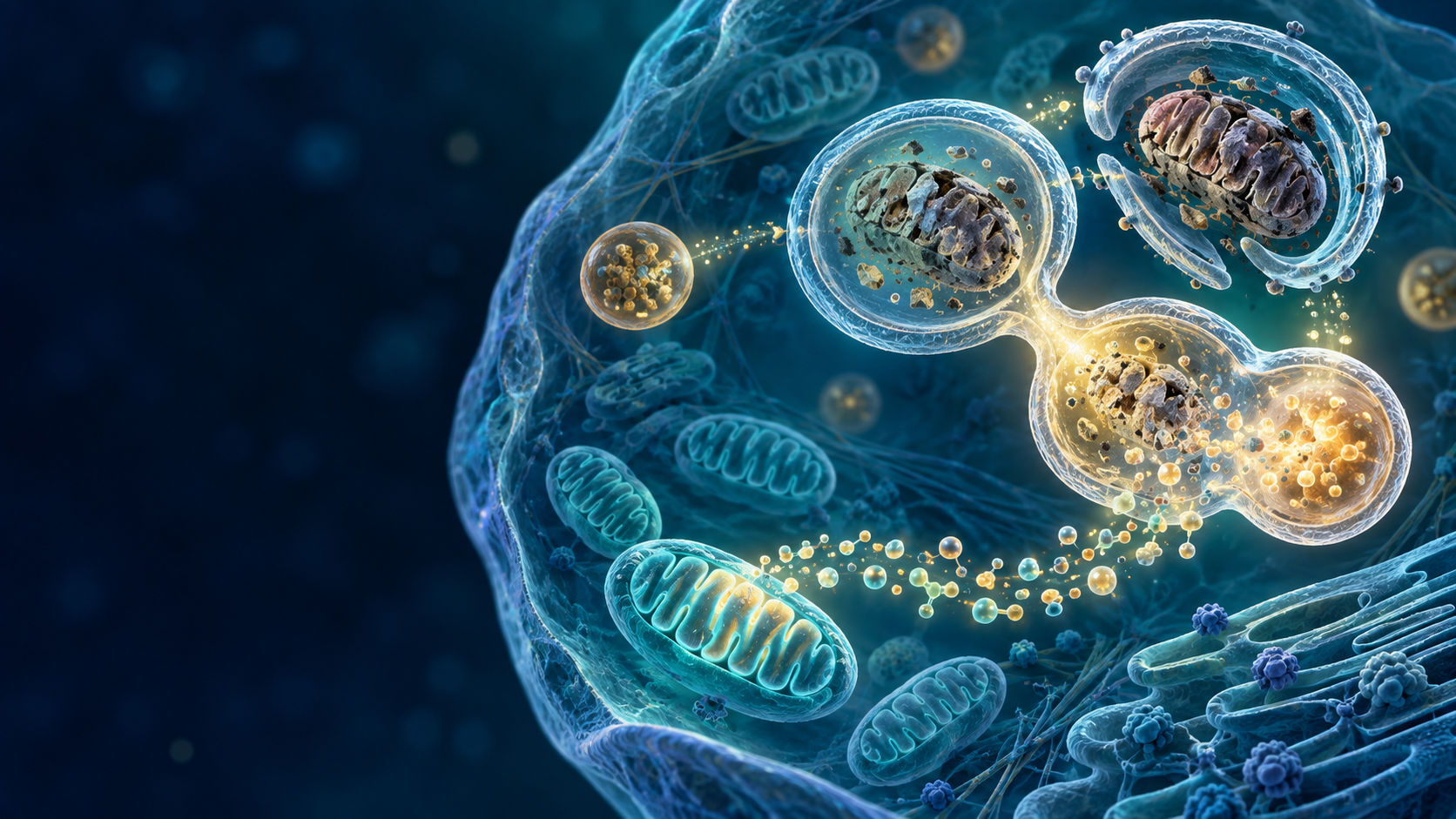
Autophagy is not a special mode that the body enters only after a certain number of hours without food. It takes place continuously within our cells, as part of the basic system that sustains life.
Few biological processes have attracted as much attention in recent years as autophagy. It is discussed in the context of intermittent fasting, metabolic health, neurodegenerative disease, and longevity. On social media it is often presented as a hidden "cleansing program" that activates once we have gone long enough without eating. The real biology is more interesting, but also far more complex.
Cells build new proteins every day, produce energy, respond to stress, and communicate with their surroundings. In the course of this work, damaged proteins, worn-out organelles, and structures that no longer function properly are generated. If all of this simply accumulated, a cell would gradually lose its ability to do its job. Autophagy prevents exactly this scenario.
What Is Autophagy, Really?
The name comes from Greek words that literally mean "to eat oneself." The term sounds dramatic, but it describes a highly rational biological process. The cell sets aside a portion of its own content that is damaged, surplus, or currently unneeded, and encloses it within a special membrane structure called an autophagosome. The autophagosome then fuses with a lysosome — a cellular compartment containing enzymes capable of breaking down biological material.
The broken-down components are not simply discarded. Amino acids, fatty acids, and other molecules can be reused to produce energy or build new cellular structures. Autophagy is therefore simultaneously a system of quality control, breakdown, and recycling.
This is not "detox" in the popular sense of the word. The liver, kidneys, lungs, intestines, and skin each play their own role in processing and eliminating substances from the body. Autophagy takes place inside the cell and deals primarily with the cell's own components — the closest description would be an internal service that continuously assesses what can be repaired, what needs to be removed, and what can be reused.
From Cellular Waste to the Nobel Prize
Although the process of cellular breakdown had been known earlier, it was the Japanese biologist Yoshinori Ohsumi who made it possible to understand its basic mechanisms. Experiments on yeast cells helped his team identify the genes required for autophagy and explain how this system is organized and regulated. For his discoveries of the mechanisms of autophagy, Ohsumi received the 2016 Nobel Prize in Physiology or Medicine.
His work did not prove that a particular diet extends human life, as is sometimes mistakenly claimed. The significance of the discovery was more fundamental: it showed that cellular recycling is not a random process, but a precisely regulated biological system essential for a cell's adaptation, maintenance, and survival. Since then, autophagy has become one of the central questions in research on aging, metabolism, immunity, cancer, and neurodegenerative disease.
In the current model of the twelve hallmarks of aging, disabled macroautophagy is recognized as a distinct hallmark in its own right. This underscores that its significance goes beyond protein control alone and extends to the removal of entire organelles and other large cellular structures.
Autophagy Is Not a Single Process
When we talk about autophagy, we usually mean macroautophagy — the process in which cellular material is enclosed within an autophagosome and delivered to the lysosome. Other forms of cellular breakdown also exist: in microautophagy, the lysosome directly takes up small portions of cellular content, while chaperone-mediated autophagy selectively recognizes specific proteins and transports them across the lysosomal membrane.
Autophagy can also be highly selective. A cell does not have to break down everything available to it at random — it can specifically remove damaged mitochondria, accumulated proteins, portions of the endoplasmic reticulum, lipid droplets, or even individual microorganisms. For this reason, it is more accurate to speak of an entire family of cellular quality-control processes than of a single switch that is either on or off.
Mitophagy — Quality Control for Cellular Energy
Mitochondria generate most of the energy a cell needs to function, while also taking part in regulating inflammation, oxidative stress, and programmed cell death. Like other cellular structures, they can become damaged — once they lose function, they may produce energy less efficiently and generate signals that place additional strain on the cell. The selective removal of damaged mitochondria is called mitophagy.
Mitophagy is not the same as destroying every older mitochondrion — it is part of a dynamic system in which damaged structures are removed while new mitochondria are simultaneously created and the existing network adapts to the cell's needs. When this control weakens, nonfunctional mitochondria can accumulate, which is why impaired mitophagy is studied in the context of aging, neurodegenerative disease, metabolic disorders, and the loss of muscle function.
What Happens to Autophagy as We Age?
With age, a cell's ability to recognize, transport, and break down damaged structures can gradually decline. The disruption can occur at any stage — from recognizing damaged material, through transport, to fusion with the lysosome and final breakdown. For this reason, more autophagosomes within a cell does not automatically mean "more autophagy" — they can also accumulate when the final stage of the process is blocked.
This is why scientists speak of autophagic flux — a cell's capacity to carry out the entire process, from recognizing material to breaking it down and recycling it. When the autophagy-lysosome system weakens, damaged proteins and organelles accumulate more easily, which can contribute to impaired cell communication, inflammation, metabolic dysfunction, and a weaker stress response.
The Brain Is Especially Dependent on Efficient Waste Removal
Neurons are long-lived cells that generally cannot simply be replaced through division, so they must keep their proteins, membranes, and organelles in functional condition for decades. In Alzheimer's, Parkinson's, and other neurodegenerative diseases, certain abnormal or misfolded proteins accumulate, and the autophagy-lysosome system plays a role in their removal.
It does not follow from this, however, that generally "activating autophagy" will prevent or cure a neurodegenerative disease. At present there is no simple fasting regimen, supplement, or commercial protocol proven to prevent Alzheimer's or Parkinson's disease in humans through autophagy.
Autophagy and Cancer — the Same Biology, Different Consequences
In healthy cells, autophagy can help remove damaged organelles and reduce cellular stress, which may limit the conditions that favor tumor formation. Once a tumor already exists, the situation can be different — malignant cells sometimes use autophagy to survive a shortage of oxygen or nutrients, or the effects of therapy.
Depending on the stage, tumor type, and cellular context, autophagy can therefore play either a protective or an unfavorable role. In people being treated for malignant disease, experimenting with prolonged fasting or supplements requires a specific assessment by the oncology team.
Does Fasting Activate Autophagy?
Reduced availability of energy and nutrients is one of the signals that can change the activity of autophagy. When a cell senses an energy shortfall, the balance between the mTOR and AMPK signaling pathways shifts — the activity of building processes can temporarily decrease, while the use of internal reserves increases. This mechanism is well documented in cell cultures, but the situation in humans is far more complex.
There is no universal number of hours after which autophagy "switches on" throughout the body — the liver, muscles, fat tissue, brain, and immune cells do not respond at the same rate. Claims that autophagy begins in everyone at exactly 16, 18, 24, or 48 hours of fasting are not scientifically justified. Autophagy is present even after a meal, simply at a different intensity — fasting can change its activity, but we do not have a simple at-home test that can determine when a given person has reached an optimal level.
Time-Restricted Eating Is Not the Same as "Autophagy Therapy"
Time-restricted eating limits the daily window during which food is consumed. The beneficial effect of such a regimen need not arise solely through autophagy — it may be related to lower total energy intake, better alignment with circadian rhythm, reduced late-evening eating, and improvements in body weight or glycemic control.
If clinical parameters improve, the intervention can be useful even when we do not know how much it has changed autophagy. Conversely, the theoretical activation of autophagy has little value if the regimen leads to loss of muscle mass, sleep disruption, overeating during the eating window, or poor control of a chronic disease. The goal is not to endure the longest possible period without food — the goal is to choose a pattern that improves health and that a person can follow safely over the long term.
Physical Activity: a Natural Signal for Renewal
Physical activity changes energy expenditure, places load on muscle cells, and demands their adaptation. During this process, mechanisms of repair, mitochondrial renewal, and quality control are activated. Experimental data show that exercise can influence autophagy and mitophagy in muscle, liver, heart, and other tissues, although the effect is not identical after every workout.
The greatest benefit of exercise is not that it "switches on autophagy," but the fact that it simultaneously improves fitness, strength, insulin sensitivity, body composition, and functional capacity. Autophagy is probably one of the mechanisms through which part of these benefits is achieved.
Can There Be Too Much Autophagy?
A biological process that is beneficial in the right context is not necessarily beneficial when it is permanently or uncontrollably active. Cells need a balance between breakdown and building — periods of repair and recycling must alternate with periods of protein synthesis, growth, regeneration, and the creation of new structures. This is especially important for muscle: older adults already face an increased risk of sarcopenia, reduced appetite, and insufficient protein intake, so aggressive fasting regimens can make it even harder for them to preserve muscle mass and function.
Similar caution is needed in pregnant and breastfeeding women, children and adolescents, people with eating disorders, malnourished patients, and those using insulin or medications that can cause hypoglycemia. Even in a healthy person, a longer fast can lead to headache, dizziness, reduced concentration, dehydration, or a diminished capacity for physical exertion. Balance matters more than extremes.
Can Autophagy Be Measured in Humans?
In research, autophagy can be assessed by analyzing specific proteins, gene expression patterns, cellular structures, and how they change over time. The problem is that no single, simple marker describes the whole process — it is necessary to assess whether material is correctly transported, fused with lysosomes, and ultimately broken down, and results from blood do not necessarily reflect what is happening in the brain, liver, or muscles.
For this reason, there is currently no routine laboratory, genetic, or functional test that can reliably determine the "level of autophagy" for the whole body. Commercial claims that autophagy can be precisely measured from a single sample, or determined from a handful of genetic variants, should be viewed critically.
Where Do Genetics and Functional Medicine Fit In?
Genetic variants can influence a large number of cellular processes, including the response to oxidative stress, metabolism, inflammation, and mitochondrial function. However, analyzing individual variants in genes such as MTHFR, COMT, SOD2, or CRP does not measure autophagy and cannot show whether this system is "switched on" or "slowed down" in a given person.
Functional and personalized medicine can contribute by connecting the medical history, body composition, metabolic status, sleep, physical activity, diet, and standard laboratory indicators. If a person has insulin resistance, visceral obesity, insufficient sleep, and low physical activity, the priority is not to prove a low level of autophagy — the priority is addressing the confirmed risk factors.
Autophagy Is Not a Goal in Itself
Autophagy is essential for life, but it is not the only process we should optimize. The body also needs protein synthesis, muscle growth, an immune response, hormone production, regeneration, and energy storage. Biological success does not arise when one signal constantly dominates, but when the body can properly shift from one state to another.
That is why the question "How do I maximally activate autophagy?" may not be the best question. It is more useful to ask: how do I support the body's ability to remove damage, renew structures, and preserve function in a timely way? The answer is probably not found in a single extreme protocol, but in a balance between movement, nutrition, sleep, recovery, and medical prevention.
Conclusion
The biggest mistake is turning a complex biological process into a marketing message that a certain number of fasting hours automatically "cleans the cells."
Autophagy is one of the fundamental systems of cellular maintenance. It recognizes and breaks down damaged proteins and organelles, recycles their components, and helps the cell adapt to changes in energy availability and other forms of stress. Its role in aging, neurodegeneration, metabolism, immunity, and malignant disease is extremely important, but it is neither simple nor always unambiguously beneficial.
We still do not know when autophagy is optimally increased in each individual, in which tissues this happens, or how clinically important such a change is. What we do know is that cells best maintain their function in a body that moves regularly, has enough time for sleep and recovery, receives good-quality food, and is not continuously exposed to metabolic excess.
We may not be able to directly control every single autophagosome. But we can create the conditions in which the body's natural mechanisms of maintenance, renewal, and adaptation are able to do their job.
AFLM — Biology Before Protocols
The Academy for Functional and Longevity Medicine translates current biological concepts into responsible clinical practice. Our goal is not to turn complex cellular processes into oversimplified promises, but to understand what the science actually shows, where the limits of the existing evidence lie, and how that knowledge can be safely applied to a specific patient.
Knowledge before technology.
The clinical question before the test.
The patient before the result.
Sources
- Ohsumi Y. Historical Landmarks of Autophagy Research. Cell Research. 2014.
- Levine B, Kroemer G. Biological Functions of Autophagy Genes: A Disease Perspective. Cell. 2019.
- López-Otín C, Blasco MA, Partridge L, Serrano M, Kroemer G. Hallmarks of Aging: An Expanding Universe. Cell. 2023.
Note: This text is educational in nature and does not constitute individual medical advice. Fasting regimens may be inappropriate or risky for certain individuals. Changes in diet, particularly in people with chronic diseases and those on medication, should be planned under appropriate professional supervision.