
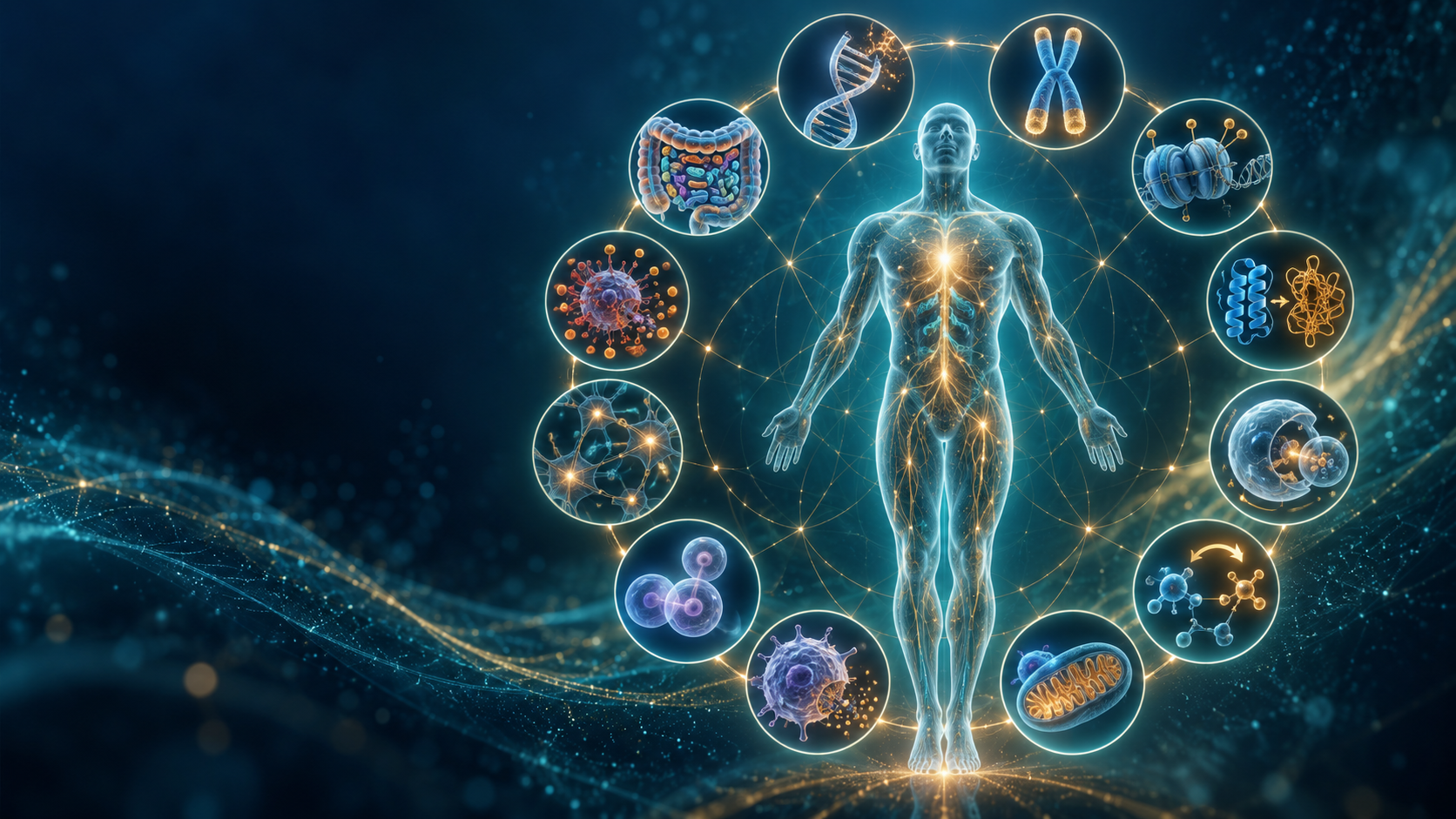
Instead of asking only how many years a person has lived, we can ask a more important question: how is their body aging?
Why do we age?
This question has occupied philosophers, physicians, and scientists for centuries. Thanks to advances in molecular biology, genetics, and medicine, we now know that aging is not a single event, nor simply a consequence of the passage of time.
Aging represents a complex network of biological changes that gradually develop in cells, tissues, and organs. As their effects accumulate, the body has more difficulty maintaining balance, recovers more slowly, and becomes more susceptible to disease.
The current scientific model describes 12 key hallmarks of aging — the Hallmarks of Aging. These are not separate causes, but interconnected processes that influence one another. Understanding them is changing the way we view health and longevity.
1. Genomic Instability — Damage to the Blueprint of Life
DNA contains the biological instructions a cell needs to function. Throughout life it is continuously exposed to various sources of damage: UV and ionizing radiation, tobacco smoke and pollution, oxidative stress, chronic inflammation, errors during DNA replication, and normal metabolic processes.
Cells possess highly efficient systems for detecting and repairing this damage. With age, however, their efficiency can decline, allowing genetic changes to gradually accumulate. The consequences depend on the type of cell, the location of the damage, and the body's ability to resolve the problem — they may include impaired cell function, cessation of cell division, programmed cell death, or an increased risk of uncontrolled growth.
2. Telomere Shortening — Protecting the Ends of Chromosomes
Telomeres are protective structures at the ends of chromosomes. They are often compared to the plastic caps on shoelaces, because they prevent damage and the fusion of chromosomes with one another. In a large number of somatic cells, telomeres progressively shorten with repeated cell divisions. When they become critically short, a cell may stop dividing, enter a state of senescence, or trigger programmed cell death.
Telomere length is linked to genetics, tissue type, age, and numerous environmental factors. Still, telomeres are neither the only nor a perfect indicator of biological age — a single measurement of their length cannot, on its own, provide a reliable assessment of overall health status, the rate of aging, or life expectancy. This result must therefore be interpreted very cautiously and within a broader clinical context.
3. Epigenetic Alterations — Genes Are Not the Whole Story
The genetic sequence is the fundamental biological record, but it is not the only factor that determines how a cell will function. Epigenetic mechanisms regulate which genes are active, when they are activated, and to what extent their information is used — without changing the DNA sequence itself. Epigenetic regulation can be influenced by aging, diet, physical activity, sleep quality, stress, smoking, pollution, disease, and medications.
Over the years, epigenetic patterns gradually change. These changes form the basis of so-called epigenetic clocks, which attempt to estimate certain aspects of biological aging. However, different clocks measure different biological characteristics, so the result should not be interpreted as a final or fixed “age of the body.”
4. Loss of Proteostasis — When Protein Control Weakens
Proteins carry out nearly all of the key tasks within a cell — they take part in energy production, communication, the immune response, the transport of substances, and tissue building. To function properly, they must be precisely synthesized, correctly folded, repaired when possible, and removed once they become nonfunctional. Maintaining this balance is called proteostasis.
With aging, quality-control systems can become less efficient, so damaged and misfolded proteins accumulate more easily and interfere with cell function. Loss of proteostasis is particularly important in the study of neurodegenerative diseases, including Alzheimer's and Parkinson's disease — this does not mean, however, that impaired proteostasis is the sole cause of these conditions.
5. Disabled Autophagy — Weaker Cellular Recycling
Autophagy is the cell's natural maintenance and recycling system. Through this process, the cell recognizes, breaks down, and reuses damaged proteins, nonfunctional organelles, parts of cellular structures, certain microorganisms, and foreign materials. Its efficiency can decline with age, which makes it easier for damaged structures to accumulate within cells.
Autophagy is often presented, in simplified terms, as a process that is “switched on” by fasting. In reality, its regulation is complex and varies among tissues. Prolonged fasting is therefore not a universal intervention — it may be inappropriate for older adults, malnourished and chronically ill individuals, pregnant women, adolescents, and people with eating disorders or certain medication regimens.
6. Deregulated Nutrient Sensing
Cells continuously assess whether the body has sufficient energy and nutrients. Based on this information, they decide whether to grow, store energy, use available fuel, repair damage, or activate recycling processes. Insulin, IGF-1, mTOR, AMPK, and other signaling pathways participate in this regulation.
The problem is not the normal rise in insulin after a meal, but long-term insulin resistance. IGF-1 participates in growth and regeneration, but its activity is not simply “good” or “bad.” mTOR promotes protein synthesis and cell growth, while AMPK is activated when the cell senses increased energy expenditure — physical activity is one of the most natural ways to engage this system. Healthy aging does not require permanently switching off growth or constantly activating energy conservation, but rather a dynamic balance between building, using energy, renewal, and rest.
7. Mitochondrial Dysfunction
Mitochondria are often called the “powerhouses of the cell,” but their role is considerably broader — they take part in producing cellular energy, regulating oxidative stress, cell signaling, controlling inflammation, and programmed cell death. With aging, the number, structure, and function of mitochondria can change, and damaged mitochondria may produce energy less efficiently.
Regular physical activity promotes the creation and functional adaptation of mitochondria, making it one of the most important interventions for preserving metabolic and functional capacity. Symptoms such as fatigue, weakness, or slower recovery, however, are not specific to mitochondrial dysfunction and require a broader clinical evaluation.
8. Cellular Senescence — “Zombie Cells”
When a cell is severely damaged, it can permanently stop dividing and enter a state of senescence. This process also has a protective role — preventing a damaged cell from dividing can reduce the risk of uncontrolled growth, and senescent cells also take part in wound healing. The problem arises when, with age, they accumulate excessively in tissues and the immune system fails to clear them efficiently enough.
Such cells can release inflammatory and other signaling molecules that alter the behavior of neighboring cells, which is why they are popularly called “zombie cells.” Senolytics — drugs and substances intended to selectively eliminate senescent cells — represent an important area of research, but they are not yet a standard therapy for slowing aging in healthy people.
9. Stem Cell Exhaustion
Stem cells enable the renewal of blood, skin, muscle, intestinal epithelium, and other tissues. During aging, their number may decrease, their function may change, their response to tissue signals may weaken, and the environment in which they reside may become damaged — all of which can slow regeneration and recovery after injury, infection, surgery, or illness.
Preserving regenerative capacity, however, does not depend on stem cells alone — circulation, nutritional status, physical activity, the hormonal environment, immunity, and the presence of chronic disease also matter. Many of the “stem cell” treatments on offer lack confirmed safety and efficacy for the indications they are marketed for.
10. Altered Intercellular Communication
Cells do not function in isolation — they continuously exchange information through hormones, neurotransmitters, cytokines, growth factors, metabolic signals, and extracellular vesicles. With age, this communication can become less precise and less coordinated, which can contribute to disturbances in sleep, metabolism, appetite, immune response, and adaptation to physical or psychological strain.
This hallmark shows why aging cannot be understood by looking at just one organ or one laboratory parameter.
11. Chronic Inflammation — the “Silent Fire” of Aging
Acute inflammation is a necessary protective response of the body to infection or injury. The problem is long-term, low-grade inflammation that can exist without clear symptoms — this process is called inflammaging. Its development can be driven by the accumulation of senescent cells, visceral fat tissue, damage to cells and mitochondria, metabolic dysfunction, impaired gut barrier function, chronic infections, smoking, physical inactivity, and disturbed sleep.
Chronic inflammation is linked to cardiovascular, metabolic, neurodegenerative, and other age-related diseases. Still, no single inflammatory biomarker can, on its own, explain the body's overall condition — results such as hs-CRP should be interpreted together with symptoms, examination findings, and other test results.
12. Dysbiosis — a Shift in the Relationship Between Humans and the Microbiome
The gut microbiome is a complex community of microorganisms that takes part in breaking down food components, producing certain vitamins and metabolites, maintaining the gut barrier, the maturation and regulation of the immune system, and communication with metabolism and the nervous system.
Dysbiosis refers to an unfavorable change in the structure or function of the microbial community and can be associated with altered gut barrier permeability, inflammation, and metabolic disturbances. However, there is no single, universally “ideal” microbiome — substantial differences exist even among healthy people, and commercial microbiome tests do not yet have equal clinical value for all indications. Testing therefore makes sense only when there is a clear clinical question and the finding can influence a further decision.
The Hallmarks of Aging Do Not Act in Isolation
The most important message of this model is not simply that 12 hallmarks exist, but that they are interconnected. DNA damage can promote cellular senescence, senescent cells can amplify chronic inflammation, inflammation can impair mitochondrial function, mitochondrial dysfunction can increase cellular stress, weaker autophagy makes it harder to clear damaged structures, and dysbiosis can contribute to inflammation and metabolic disturbance. Aging therefore resembles a network more than a linear path.
The good news is that certain interventions can simultaneously benefit several parts of this network. Still, “influencing the mechanisms of aging” is not the same as proven extension of an individual's lifespan. In humans, the most reliable goals remain reducing disease risk, preserving function, and extending the period of life spent in good health.
What Can We Practically Do Today?
The strongest evidence does not exist for a single pill, supplement, or test, but for the consistent application of basic prevention principles.
- Move regularly: at least 150–300 minutes of moderate-intensity aerobic activity per week, plus strength training at least twice a week.
- Preserve muscle mass and strength — through resistance training, adequate protein intake, quality sleep, and proper recovery.
- Protect metabolic health: monitor waist circumference, blood pressure, blood glucose, HbA1c, lipid profile, and liver function.
- Ensure quality sleep — snoring, breathing pauses, and marked daytime sleepiness may warrant a medical evaluation.
- Choose a high-quality dietary pattern based on vegetables, legumes, whole grains, fish, and olive oil.
- Reduce harmful exposures: smoking cessation, a responsible approach to alcohol, and protection from UV radiation.
- Cultivate social and psychological resilience — relationships, a sense of purpose, and timely psychological support.
Where Do Genetics and Functional Medicine Fit In?
Genetic tests can help identify certain inherited predispositions and pharmacogenetic variants. A genetic predisposition, however, is not a diagnosis, and the absence of a known variant is not a guarantee of protection. The clinical value of a genetic test depends on the quality and validity of the analysis, the strength of the variant's association with a specific outcome, the overall health context, and whether the result can change a concrete decision.
Functional and other specialized analyses can, in selected situations, provide additional information about hormonal patterns, the daily cortisol rhythm, metabolism, the microbiome, or nutritional status. On their own, they cannot prove “accelerated aging” or replace standard medical diagnostics. A test should answer a question — the question should not be sought only after the result arrives.
Can We Slow Aging?
It is possible to influence certain biological processes associated with aging. This, however, does not mean that the entire process of aging can be stopped or reversed. Senolytics, rapamycin, metformin, NAD⁺ precursors, gene therapies, and cellular reprogramming represent important areas of research, but for most of these approaches we still lack sufficient evidence of long-term safety and clinical benefit in healthy people.
That is why it is essential to clearly distinguish between results obtained in cell cultures, results from animal studies, early clinical trials, proven benefit for patients, and a regulatory-approved medical indication. Longevity medicine must be scientifically curious, but at the same time clinically responsible.
Conclusion
We may not be able to stop time. But we can better understand the biology of aging, reduce known risks, and make decisions that increase the likelihood of staying healthy and functional for longer.
The twelve hallmarks of aging provide a modern framework for understanding what changes in our cells and tissues over the years. They show that aging is not a single process and cannot be assessed by one biomarker, one genetic result, or one commercial test. Genes, metabolism, mitochondria, proteins, inflammation, regeneration, and the microbiome form an interconnected biological network.
The goal of modern longevity medicine is therefore not simply extending life. The goal is extending the period of life during which health, physical and cognitive function, independence, adaptability, and quality of life are preserved.
AFLM — Knowledge Before Technology
The Academy for Functional and Longevity Medicine connects current scientific knowledge with responsible clinical practice. Through professional training, clinical case studies, and hands-on workshops, we build the knowledge needed to correctly interpret biomarkers, genetic and functional tests, and to safely integrate them into personalized medicine.
Knowledge before technology.
The clinical question before the test.
The patient before the result.
Sources
- López-Otín C, Blasco MA, Partridge L, Serrano M, Kroemer G. Hallmarks of Aging: An Expanding Universe. Cell. 2023;186:243–278.
- López-Otín C, Blasco MA, Partridge L, Serrano M, Kroemer G. The Hallmarks of Aging. Cell. 2013;153:1194–1217.
- Kennedy BK, Berger SL, Brunet A, et al. Geroscience: Linking Aging to Chronic Disease. Cell. 2014;159:709–713.
- World Health Organization. Guidelines on Physical Activity and Sedentary Behaviour. Geneva: WHO; 2020.
- Volkert D, Beck AM, Cederholm T, et al. ESPEN Practical Guideline: Clinical Nutrition and Hydration in Geriatrics. Clinical Nutrition. 2022;41:958–989.
Note: This content is educational in nature and does not constitute individual medical advice. Laboratory and genetic testing, dietary changes, fasting regimens, supplements, and medications require individual assessment, particularly in people with chronic diseases and existing therapy.